
Course overview
| Who it is for | Doctors, nurses, medical assistants, primary care professionals, dentists, psychologists, physiotherapists, healthcare managers and other healthcare professionals |
| Format | Intensive, online, blended, at our language institute in the Netherlands, or as team training for healthcare teams |
| Level | For healthcare professionals who want to improve, refine or use their English with greater confidence |
| Content | Patient conversations, triage, giving explanations, asking questions, providing reassurance, family conversations, written communication and discussions with colleagues |
| Materials | You work with situations, conversations and terminology from your own healthcare practice |
| Goal | To communicate more clearly, carefully and confidently in English |
English course for healthcare professionals
- Speaking with patients and clients in English
- Triage, intake and telephone communication
- Family conversations and sensitive situations
- Working with international colleagues
- Practising with situations from your own healthcare practice
- The Regina Coeli approach
- Frequently asked questions about English for healthcare professionals
Communicating calmly and empathetically in English
English in healthcare requires more than general language skills. You often communicate with people who are uncertain, anxious, unwell or worried. You need to be clear, but also calm and empathetic. You want to explain medical information without using language that is unnecessarily complex. You also need to respond when someone is in pain, becomes emotional or does not understand something.
Sometimes you need medical terminology. At other times, you need simple and reassuring language that helps a patient or client feel at ease.
Many healthcare professionals already speak English. Even so, it can be difficult to communicate with the same confidence and calm that you have in your first language. You know what you want to say, but may need time to find words that are clear, professional and human.
That is why English for healthcare professionals at Regina Coeli is not based on separate vocabulary lists. It focuses on communication in your own practice, with your patients or clients, your role, your situations and your professional goals.
Speaking with patients and clients in English
When speaking with patients or clients, you want to communicate clearly, calmly and professionally. You need to welcome the person, understand the situation and explain what will happen next.
You can work on language for:
- asking about symptoms and concerns
- discussing pain, symptoms or worries
- asking follow-up questions in a calm way
- explaining medical information in clear language
- giving instructions
- setting clear expectations
- providing reassurance
- responding with empathy
This helps you develop language that suits your role and feels natural when speaking with patients or clients.
Triage, intake and telephone communication
On the telephone, at reception or during an intake, you often need to respond quickly. You want to collect the right information, identify priorities and clearly explain what the person can expect.
You can practise how to:
- clarify why someone is seeking help
- ask for contact details and practical information
- organise information about symptoms or concerns
- ask follow-up questions
- explain urgency and next steps
- refer someone to another professional or service
- make or change an appointment
- remain calm when someone is worried
This is especially useful for medical assistants, primary care professionals, nurses, reception staff and other professionals who are often the first point of contact.
Explaining examinations, treatment and medication
As a healthcare professional, you need to make medical information easy to understand. Not everyone is familiar with medical terminology, especially in English. You therefore need to explain what will happen, why it is necessary and what the patient or client needs to do.
You can work on:
- explaining examinations and tests
- explaining treatment
- giving preparation or aftercare instructions
- discussing how medication should be used
- giving lifestyle advice
- explaining risks or side effects
- discussing follow-up appointments
- checking that the person has understood your explanation
Family conversations and sensitive situations
\Some conversations require extra care. You may need to speak with worried family members, emotional patients or people who are dealing with bad news, uncertainty, resistance or misunderstandings. In these situations, you want to communicate calmly and compassionately.
You can practise how to:
- acknowledge concerns
- communicate difficult information carefully
- answer questions from family members
- explain limits or available options
- show understanding while remaining clear
- repeat and summarise important information
- explain the next steps
- bring the conversation to a professional close
Working with international colleagues
Many healthcare organisations have colleagues from different language and cultural backgrounds. English may be needed during meetings, handovers, training sessions or cooperation with external partners.
You can practise how to:
- hand over information
- ask colleagues questions
- discuss a patient case
- give instructions
- provide feedback
- respond professionally during meetings and discussions
Informal conversations with patients, clients and colleagues
Healthcare is also about human contact. Brief informal conversations can help someone feel at ease and support a stronger professional relationship. This may include small talk during treatment, a conversation on the ward or an informal chat with an international colleague.
You can practise conversations about everyday life, work, family, culture, current events or personal interests. When you feel more confident in informal conversations, you will often communicate more freely in formal healthcare situations as well.
Practising with your own healthcare practice
Because the training is personal, you can use situations and materials from your own work. Instead of practising with fictional standard situations, you work with language that is relevant to your role, workplace and patients or clients.
Examples include:
- consultations
- intake conversations
- triage conversations
- patient conversations
- family conversations
- treatment and aftercare instructions
- explanations about medication
- difficult conversation scenarios
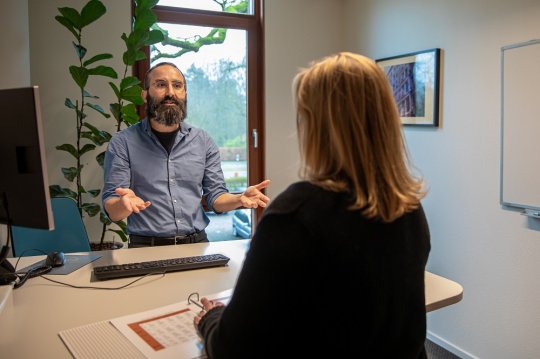
The Regina Coeli approach
At Regina Coeli, language learning is based on personal attention, full focus and targeted guidance. You do not follow a fixed programme. Instead, you work on the communication you need to perform more effectively in your healthcare practice.
We start by looking at your situation:
- What is your role?
- Who do you communicate with in English?
- What types of conversations do you have?
- What information do you often need to explain?
- Which words, sentences or situations do you find difficult?
- Which situations are currently challenging for you?
- Would you mainly like to communicate more clearly, naturally, carefully, empathetically or confidently?
Your training is then built around your personal learning goals. These may include consultations, triage, telephone calls, giving explanations, family conversations, written communication or cooperation with colleagues.
You may also work on pronunciation, spontaneity, small talk, cultural awareness or finding the right tone.
In this way, you do not learn English as a separate skill. You develop it as part of your professional communication in healthcare.
Request a free consultation
At Regina Coeli, you work on the English you need in your professional practice. There is no standard course. You receive personal language training that matches your role, learning goals and international work situations.
Would you like to find out what a tailored English programme could look like for your healthcare role? Explore the possibilities at Regina Coeli or contact us for personal advice.
Vraag een adviesgesprek aan
Frequently asked questions about English for healthcare professionals
Does Regina Coeli offer a standard medical English course?
No. Regina Coeli provides personal, tailored language training. We can help you with medical English and English for healthcare, but the content is adapted to your role, level, learning goals and daily work.
Will I learn medical terminology during the course?
You work on the medical language that is relevant to your role. You provide the professional content, such as your own situations, terminology, documents, protocols or conversation topics. Our language trainers help you use this content clearly, correctly and professionally in English.
Is the training mainly for healthcare professionals who plan to work abroad?
Not necessarily. Many healthcare professionals need English in their current workplace, for example when communicating with international patients, clients, family members or colleagues.
Are you planning to use English for work or study in another country?
We can also adapt your learning goals to this situation.
Can I practise conversations with patients or clients?
Yes. You can practise conversations that are important to you. These may include intake conversations, consultations, triage, explanations about treatment, medication, aftercare, lifestyle advice or follow-up appointments.
Can I also work on pronunciation and speaking fluently?
Yes. Pronunciation, intonation, pace, spontaneity and natural language use can all be part of the training. This can be especially useful when you already speak English reasonably well but want to sound calmer and more professional.
Is this course suitable if I already speak English well?
Yes. Many healthcare professionals come to Regina Coeli because they want to refine their English. For example, they may want to communicate more clearly, empathetically, naturally or confidently.