What is the best way for you to learn Dutch?
You have decided that you want to improve your Dutch. Perhaps you no longer want to rely on English in everyday situations. Perhaps you need Dutch for your career, your family life or your confidence in the Netherlands. Or perhaps you simply want to feel more at home.
Whatever your reason, learning Dutch successfully is not only about motivation. It is also about choosing an approach that fits your goals, your daily life and the way you learn best.
There is no single best way to learn Dutch. The best method is the one that helps you make real progress.

Start with your reason for learning Dutch
Before choosing a Dutch course, it helps to be clear about your reason for learning the language. What do you want Dutch to make possible for you?
You may want to use Dutch to:
- take part more actively in meetings;
- write clearer emails;
- speak more easily with colleagues;
- give presentations with greater confidence;
- talk to your neighbours;
- understand letters from school;
- have a proper conversation with your child’s teacher.
The more specific your goal is, the easier it becomes to choose the right way to learn.
Ask yourself: “I want to be able to use Dutch when…”
Your answer gives direction to your learning journey.
Know what is holding you back
Many people who want to learn Dutch already know more than they think. They understand parts of conversations, recognise words and may even be able to manage simple situations. Yet they still hesitate to speak.
Sometimes the obstacle is grammar. Sometimes it is pronunciation. Sometimes it is a lack of vocabulary. And very often, it is confidence.
You may recognise thoughts such as:
- “I’m not good at languages.”
- “I understand Dutch, but I don’t dare to speak.”
- “I’m afraid of making mistakes.”
- “I always switch back to English.”
- “I don’t have enough time to practise.”
These doubts are normal. But they are also useful, because they show you what kind of support you need.
If you are afraid of making mistakes, you need a safe learning environment. If you struggle with pronunciation, you need personal feedback. If you lack structure, you may need a course that gives you rhythm, focus and guidance.
Choose a method that fits the way you learn
There are many ways to learn Dutch: apps, books, online exercises, group lessons, self-study and intensive individual training. Each method can be useful, depending on your goal.
For example:
- Apps and online tools can help you practise vocabulary and grammar.
- Books can give structure and explanation.
- Group lessons allow you to learn together with others.
- Self-study can work well if you are disciplined and already know what to improve.
- Individual training is useful if you want personal feedback and targeted progress.
But if you want to make focused progress, personal guidance can make a significant difference. In individual lessons, the training can focus entirely on your level, your questions and the situations in which you want to use Dutch.
That means you do not spend time on language you already know or topics that are not relevant to you. You work on the Dutch that helps you move forward.
Learn through real interaction
Language is not something you only learn from a book. You learn a language by using it.
That is why interaction is essential. You need to hear how native speakers use Dutch. You need to practise speaking, receive corrections and try again. You need to become familiar with rhythm, pronunciation, expressions and the small details that make a conversation feel natural.
“The best language training starts with the situations in which someone actually wants to use the language.”
This is especially important if you want to use Dutch in professional or social situations. It is not enough to know the right words. You also need to feel confident enough to use them at the right moment.
A good Dutch course gives you the opportunity to practise actively, make mistakes safely and receive immediate feedback.
Be honest about the support you need
Learning Dutch takes commitment. It helps to think honestly about the support you need to succeed.
Ask yourself:
- Do I have enough discipline for self-study?
- Do I learn better with a clear schedule?
- Do I need personal guidance?
- Can my employer give me time to study?
- Can colleagues help me practise Dutch at work?
- Would it help to tell people around me that I am learning Dutch?
Support can come in many forms: time, encouragement, structure, feedback and opportunities to practise.
At Regina Coeli, support is built into the learning process. You follow a clear rhythm of lessons, independent study and practice. You work with highly educated native-speaker trainers, and your course is tailored to your goals and learning style.
Make your Dutch learning plan realistic
Once you know your goal and the type of support you need, you can make a realistic plan.
A good plan answers three questions:
What do I want to be able to do in Dutch?
For example, join meetings, speak with clients or manage everyday conversations.
How much time can I dedicate to learning?
Some people prefer to learn gradually. Others choose an intensive course because they want to make progress quickly.
How will I keep using Dutch afterwards?
Progress continues when you use the language in real situations after your course.
There is no right or wrong choice. What matters is that your plan suits your situation and gives you the best chance of continuing after the course.
A Dutch course tailored to you
At Regina Coeli, you do not follow a standard programme. Your Dutch training course starts with your current level, your goals and the situations in which you want to use the language.
You learn from native speakers in individual lessons. You receive personal feedback, practise actively and work with materials that support your learning process. The course is designed to help you use Dutch with more confidence in your work and daily life.
This makes Regina Coeli a strong choice if you are looking for a Dutch course that is personal, intensive and focused on real progress.
Dutch language training at Regina Coeli
Immerse yourself in Dutch at Regina Coeli.
Would you like to know if a course at Regina Coeli is suitable for you? Then call one of our Client Services employees on +31 (0)73 - 684 87 53 (available between 9.00 and 17.00).
Read more about Dutch training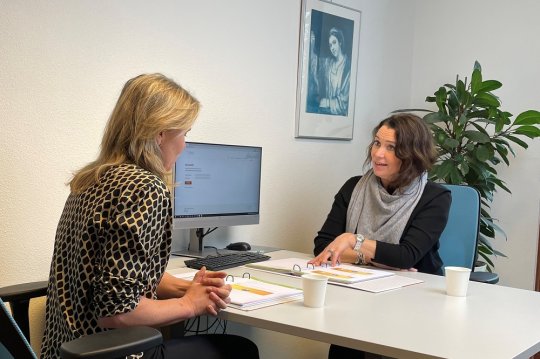
More about Dutch language and culture

How to improve your Dutch pronunciation
For many internationals, Dutch pronunciation is one of the hardest parts of learning the language. The good news is that pronunciation can be trained. Improvement usually does not come from trying to sound perfect straight away. It comes from becoming more aware of how Dutch sounds, how your own pronunciation differs, and what you can adjust step by step.
Business Dutch starts with the words you need
Amsterdam is not the easiest place to learn Dutch. At the slightest sound of a foreign accent, a kind, sympathetic Dutch person immediately breaks into English! This has happened so many times to Sofia Derossi, an Italian, who has lived in Amsterdam for three years now.
Learning Dutch for Work: What Professionals Really Need
For many internationals in the Netherlands, Dutch starts as something useful for daily life. You learn enough to order food, speak to a neighbour or understand a message from school or the doctor. In many workplaces, English is enough too, at least in the beginning. But at some point, many professionals notice that everyday Dutch is no longer enough.