Business Dutch starts with the words you need
Sofia Derossi could already speak Dutch. She had lived in Amsterdam for three years and had passed the NT2 state exam. In everyday situations, she could manage quite well.
But when she started working for a small advisory firm outside Amsterdam, she discovered that business Dutch was a different challenge.
Answering the phone, contributing to meetings and finding the right words in a professional context required more than general language knowledge. Sofia did not need to start from scratch. She needed Dutch that worked at work.

From general Dutch to business Dutch
Amsterdam is not always the easiest place to practise Dutch. At the slightest sound of a foreign accent, many Dutch people switch to English immediately. Sofia had experienced that many times.
Still, she had managed to learn a good level of Dutch. She had studied, practised and passed her exam. But in her new job, she noticed that passing an exam and using Dutch professionally are not the same thing.
“To come across professionally, I really needed to expand my vocabulary and improve my pronunciation, but most of all I had to build up my confidence,” Sofia explains. “At work, I’m the only one who isn’t a native Dutch speaker, and that’s not always easy.”
The situations that were difficult for her were very concrete.
“I was anxious about answering the telephone and sometimes, during meetings, I wasn’t able to react quickly enough in the discussion to get my point across.”
That is often where business Dutch becomes challenging. You do not only need to understand the language. You need to respond at the right moment, choose words quickly and express yourself clearly in your own professional role.
The words you need at work
Business Dutch is not one fixed set of words. It depends on your work, your sector, your role and the conversations you have.
A consultant needs different Dutch from an HR manager. A doctor needs different Dutch from an engineer. Someone who gives presentations needs different language from someone who mainly writes emails or speaks to clients by phone.
That is why expanding your vocabulary only works well when the words are relevant to your context.
Learning long lists of general words is rarely the most effective way to improve your professional Dutch. It is much more useful to learn words in the situations where you actually need them.
For Sofia, that meant working on Dutch she could use in her advisory role: words for meetings, phone calls, professional explanations and nuanced reactions.
Learning vocabulary in context
A word becomes easier to remember when you learn it in context. You do not only learn what it means; you learn when to use it, how it combines with other words and what kind of sentence it belongs in.
That makes your vocabulary more active. The word is no longer something you recognise when you see it. It becomes something you can use when you speak.
For example, it is useful to learn words and phrases for situations such as:
- opening a phone conversation;
- explaining a problem;
- asking a follow-up question;
- giving advice;
- expressing doubt or nuance;
- interrupting politely;
- responding in a meeting;
- summarising an agreement;
- closing a conversation professionally.
These are not random words. They are the building blocks of your working day.
A personal word web for business Dutch
During her course at Regina Coeli, Sofia learned to use word webs: a structured way of collecting and practising vocabulary around a specific theme or situation.
A word web can include individual words, fixed expressions, sentence starters and phrases that you often need. It becomes a personal vocabulary tool, built around your own work.
For Sofia, this approach worked very well.
“I learned how to make word webs during my course. This is a structured way of learning vocabulary that works extremely well for me, for example words useful in my line of work or words expressing emotions.”
This is exactly what makes business Dutch personal. You do not need every Dutch word. You need the words that help you do your job better.
A useful word web might focus on:
- vocabulary for your field;
- words you need in meetings;
- phrases for phone calls;
- ways to express agreement or disagreement;
- words for giving feedback;
- phrases for presenting advice;
- vocabulary for emotions or sensitive situations;
- common words that are difficult to use correctly.
This makes learning more practical and more manageable. Instead of trying to “improve your Dutch” in general, you work on the language that has immediate value.
Making de and het practical
For many people learning Dutch, de and het are a constant source of frustration. There are rules, but in a real conversation you do not have time to search through those rules in your head.
That is why Regina Coeli’s trainers make grammar practical and relevant to the learner’s own language use. There are rules for the use of de and het, but during a conversation you don’t have your list of rules at hand. So it’s a good idea to focus on, for instance, work-related vocabulary with the correct article in front.
Sofia made this very concrete. At work, she kept a word web open on one of her screens with the het words she often used.
“At work, I always have a word web open on one of my screens with all the words that I often use beginning with het. So I’m making far fewer mistakes now with de and het.”
That is a small habit with a big effect. It turns a general grammar problem into a practical working tool.
Speaking professionally does not mean speaking perfectly
When you use Dutch at work, it is easy to think that every sentence has to be perfect. But professional communication is not the same as flawless language.
The first goal is to get your message across. After that, you can work on structure, pronunciation and style. That insight helped Sofia. She learned that she did not need perfect Dutch to participate professionally. She needed enough language, structure and confidence to say what she wanted to say.
Even in presentations, being a non-native speaker does not have to be a weakness. If you’re giving a presentation and you tell the audience that you’ve been learning Dutch, it can actually be an ice-breaker. The Dutch respect someone who has only lived in the Netherlands for three years and is already able to speak the language well.
More confident in phone calls and meetings
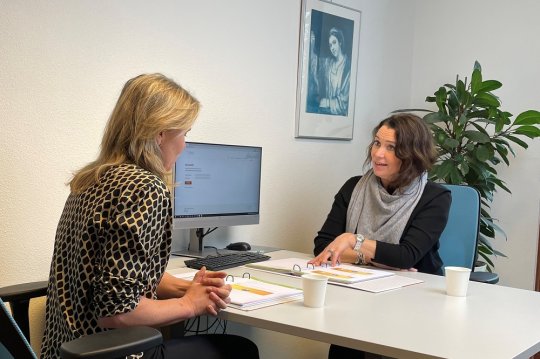
During her five-day training course at Regina Coeli, Sofia worked with her trainers on the situations that mattered most in her job. She expanded her vocabulary, improved her grammar and practised speaking in professional conversations.
One practical discovery made a real difference.
“I discovered that once I had got through the first two sentences in Dutch, the rest of the conversation went well. So I concentrated on practising the beginnings of conversations.”
That is a good example of how specific business Dutch can be. Sometimes the key to a better phone call is not learning hundreds of new words. It is practising the opening sentences until they feel natural.
For meetings, the challenge may be different. You may need phrases to enter the conversation quickly, such as:
“May I add something?”
“I see it slightly differently.”
“Could I come back to that point?”
“What I would like to suggest is…”
“In my experience, this usually means that…”
These kinds of phrases help you react faster. They give you a way into the conversation, so you do not miss the moment to speak.
Dutch that belongs to your work
Sofia’s course was tailor-made. For five consecutive days, she worked with her trainers on the Dutch she needed in her professional context.
That is the essence of business Dutch at Regina Coeli. The training does not start with a standard list of business words. It starts with your work.
What do you need to say?
Who do you speak to?
Which situations make you hesitate?
Which words do you often search for?
Where do you want to sound more professional?
From there, your trainers help you build the vocabulary, grammar, pronunciation and speaking skills that fit your situation.
For Sofia, the result was clear.
“I am able to communicate much more easily in Dutch now. And do you know what is really great? In Amsterdam, people now actually answer me in Dutch!”
Improve the Dutch you need for your work
Business Dutch starts with the words you need. Not with abstract vocabulary lists, but with the language of your meetings, phone calls, presentations, clients, colleagues and professional expertise.
Would you like to use Dutch more confidently at work? At Regina Coeli, your Dutch course is tailored to your level, your role and the situations in which you need the language.
Read more about Dutch language training at Regina Coeli
More about Dutch language and culture

Learning Dutch for Work: What Professionals Really Need
For many internationals in the Netherlands, Dutch starts as something useful for daily life. You learn enough to order food, speak to a neighbour or understand a message from school or the doctor. In many workplaces, English is enough too, at least in the beginning. But at some point, many professionals notice that everyday Dutch is no longer enough.
How to improve your Dutch pronunciation
For many internationals, Dutch pronunciation is one of the hardest parts of learning the language. The good news is that pronunciation can be trained. Improvement usually does not come from trying to sound perfect straight away. It comes from becoming more aware of how Dutch sounds, how your own pronunciation differs, and what you can adjust step by step.
From understandable Dutch to powerful Dutch
Many people who learn foreign languages would like to sound like native speakers. But even when you exclusively speak the new language for years, you can still end up with a noticeable accent. How can you work on proper pronunciation from the start? We spoke about this with Yvonne Tupker, a speech therapist and Dutch language trainer at Regina Coeli.