Speaking Dutch helps you understand the Dutch

You can live and work in the Netherlands without speaking Dutch. Tax matters, banking, everyday conversations and even many jobs can be managed in English. If Dutch people hear that you are not from the Netherlands, they often switch to English immediately.
Niina Pussinen knew that from experience. In her job at ABN AMRO, she did not need Dutch to do her work. And yet, at a certain point, she decided to learn the language properly.
“In practical terms, you can get by in English,” Niina says. “But I still felt I was missing something.”
At first, speaking Dutch was anything but easy.
“It felt like running a 100-metre dash on one leg and with two hands tied behind my back. I had lived in the United States, so I spoke English well. That made it frustrating to take the leap and speak only Dutch. But I’m thrilled I kept at it.”
English gets you far, but not all the way
Like many expats, Niina had learned some Dutch, but she did not practise enough to communicate with confidence. At first, that did not seem like a problem.
“I wasn’t initially planning on staying in the Netherlands for long. I learned Dutch because I like learning languages. But I also felt quite insecure not speaking the language that everyone around me spoke.”
That feeling became especially clear in everyday situations.
“You don’t have a clue what people are saying. If people at the train station start running after hearing an announcement, you don’t know what to do. Should you run, too?”
For Niina, learning Dutch was not only about speaking the language herself. It was also about understanding what was happening around her.
Dutch directness starts to make sense when you speak Dutch
Learning Dutch gave Niina more than vocabulary and grammar. It helped her understand the Dutch way of communicating.
“The Dutch communicate very differently from what I was used to. I really had to get used to the directness. At first, I thought it was blunt and impolite. But once I started communicating more directly myself, I noticed that it worked.”
By speaking the language, Niina began to understand not only what people said, but also why they said it that way. Dutch communication is often clear, concise and to the point. Once you recognise that style, conversations become easier to interpret. Once you adopt it yourself, you can communicate more effectively.
“By adopting their communication style, you can better understand the Dutch.”
Niina also noticed how language reflects culture in small ways.
“One thing I find funny is that time often comes at the beginning of a sentence in Dutch. That makes sense, because time is such an important concept in the Netherlands.”
Communicating clearly and confidently in Dutch
Thanks to her perseverance, Niina now speaks Dutch without hesitation in her work. She manages a team and regularly gives presentations: “a really chatty job”, as she calls it.
“I can express myself well and I feel that I’m understood. But I wanted to improve my Dutch even further, so I contacted Regina Coeli.”
During her Dutch course, Niina focused on communicating as effectively as possible, both in writing and speaking. Her trainers worked with her on structure, intonation and clear, concise formulation.
“The trainers taught me more about structure and intonation, and also about communicating clearly and concisely. The Dutch just love it.”
That made the course directly relevant to her work. She was not simply learning more Dutch; she was learning to communicate better in a Dutch professional context.
Working on personal language challenges
Every non-native speaker has specific challenges. For many learners of Dutch, the articles de and het are a familiar difficulty. When do you use which one?
For Niina, her trainer made the issue practical.
“A trainer gave me simple tips so I would make fewer mistakes with de and het. Now I have a list of the het words I often use at work. If the word is on my list, I automatically know it’s a het word.”
This kind of focused attention is one of the strengths of individual training. Instead of following a general programme, you work on the language issues that matter most in your own situation.
Individual training with different trainers
Niina followed an individual training programme with four different trainers. Each trainer worked with her for one hour a day.
“The strength of the programme is that it’s individual and that you have different trainers. Because of this approach, all the lesson materials could be fine-tuned to my particular situation. You cannot even begin to compare that approach to a group training programme.”
This way of working allowed the trainers to focus on Niina’s specific challenges. Her course was not built around a standard curriculum, but around her level, her goals and the Dutch she needed in her daily work.
A simple tip: speak more sloooowly
Niina is still learning. After finishing her course at Regina Coeli, she continues to improve her Dutch on her own. One of her most useful insights is surprisingly simple: slow down.
“I’m a very enthusiastic person, which means I often speak too fast. Then I don’t give myself enough time to think about things like sentence structure. So my tip is: speak more sloooowly.”
To remind herself, she even drew a pause button on the back of her phone.
“It reminds me to slow down and come up for air now and then.”
It is a small practical tool, but it says a lot about learning a language well. Speaking better Dutch is not always about using more difficult words. Sometimes it is about creating enough space to communicate clearly.
Learn to communicate more naturally in Dutch
Learning Dutch can help you understand more than the language itself. It can help you understand how people communicate, how decisions are made and how to express yourself more effectively in a Dutch context.
For Niina, speaking Dutch changed the way she connected with people around her. It helped her feel more confident, more independent and more at ease in Dutch professional life.
Interested in following language training at Regina Coeli?
Would you like to communicate more confidently and naturally in Dutch? At Regina Coeli, your training is tailored to your level, your goals and the situations in which you use Dutch.
Read more about Dutch language training at Regina Coeli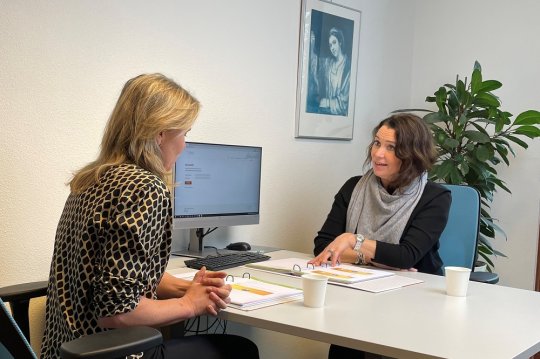
More about Dutch language and culture
How learning Dutch can help you feel more at home in the Netherlands
You moved to the Netherlands for a reason. A job, a new opportunity, a fresh chapter in your life. You want to succeed at work, enjoy your time here and feel that you are building a life that truly works for you. Learning Dutch can help with that. A few words, a short conversation or the confidence to join in can already make the Netherlands feel more like home.
How to get Dutch people to speak Dutch with you
You start a conversation in Dutch. The other person hears your accent, smiles kindly and replies in English. For many expats in the Netherlands, this is a familiar situation. Dutch people often switch to English because they want to be helpful. In many situations, that is convenient. But if you are trying to improve your Dutch, it can also be frustrating. So how do you encourage Dutch people to keep speaking Dutch with you?
How to improve your Dutch pronunciation
For many internationals, Dutch pronunciation is one of the hardest parts of learning the language. The good news is that pronunciation can be trained. Improvement usually does not come from trying to sound perfect straight away. It comes from becoming more aware of how Dutch sounds, how your own pronunciation differs, and what you can adjust step by step.