Communicating in Arabic can be an art in itself
You don't often think about how you communicate. Words usually come naturally. When you speak a foreign language, you may be more aware of this. Communication consists of more than just words. For example, if you want to speak Arabic, tone, body language and context are just as important as the literal message.
This article is about the communication style in the Arabic-speaking world. Read on if you want to start learning Arabic or improve your knowledge of Arabic.
Indirect is tactful
Communication in Arabic cultures often revolves around maintaining harmony and avoiding direct confrontation. That is why people often use a roundabout way of making their meaning clear. A “yes” means that someone has heard you, rather than that they agree with you. And a direct “no”? You rarely hear that, especially when there is a hierarchical relationship involved. Instead, you are more likely to hear something like, “We will look into it, Insha'Allah”.
Use your antennae
Precisely because Arabic is indirect, facial expressions, intonation and hand gestures say a lot about what someone really means. So language skills alone are not enough. You will also need to be able to empathise with Arab culture.
Business: formal and hierarchical
In a professional context, formal forms of address are used and there is great respect for hierarchy. Titles are usually combined with the first name, such as Professor Mohamed.
In emails, you will often see traditional greetings and formal forms of address such as hadritak (m.) or hadritik (f.). In conversation, these are sometimes replaced by the more informal forms enta (m.) or enty (f.). This depends on the level of trust between the parties.
Social: warm and personal
The tone is very different outside the context of work. Social conversations are personal and cordial. People compliment each other, ask how they are doing and how their family is doing.
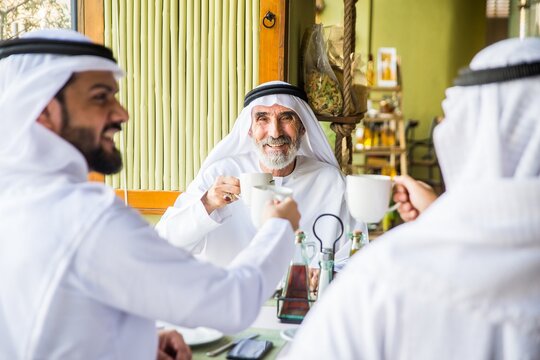
Drinking tea
In the Arabic-speaking world, personal meetings are the key to successful relationships, especially in business. Of course, a lot also happens online, especially among younger generations and the tech-savvy countries in the Gulf region. But even there, real connections are only made through personal contact.
For those building long-term partnerships, the rule is: visit, drink tea and invest in the relationship.
Between the lines...
If you are used to direct communication and are task-oriented, it can be challenging to adapt to the Arabic communication style. Slow down, ask questions, suggest thinking about an alternative together instead of immediately giving your opinion.
Learning Arabic well
If you want to communicate in Arabic, knowledge of the culture is just as important as the language. During an Arabic course at Regina Coeli, both language and culture are covered. You will learn this during an individual programme in which we take into account the country you are in contact with, your industry and your level of language proficiency.
View the Arabic course
Also interesting for you

Reading from right to left... Arabic script does all sorts of things to your brain
When you learn Arabic, you not only master a new language, you also challenge your brain in ways you might not expect. One of the most striking differences between, for example, English is the direction of writing: Arabic is read and written from right to left. And that demands something of your brain.
Six cultural insights for doing business successfully in the Gulf region
The Gulf region offers huge opportunities for entrepreneurs, consultants, and service providers. But to succeed, you need to understand the culture. Even in ultra-modern cities like Dubai, Doha, and Riyadh, business runs on different rules, rules rooted in tradition. In this article, you'll learn what makes the Gulf region unique and how to adapt your approach for better communication and long-term success.
What Insha’Allah really means and what it reveals about Arabic communication
If you’ve spent time working or living in an Arabic-speaking environment, chances are you’ve heard the phrase Insha’Allah — “If God wills it.” At first glance, it may sound like a purely religious expression, but there's much more beneath the surface. In Arabic-speaking cultures, communication is a delicate art. To understand the people, the language, and the choices behind everyday conversations, it helps to understand not just what is said, but how it’s said. And often, what’s left unsaid.