A small guide to Dutch football words, habits and orange streets
If you live in the Netherlands during the World Cup or another tournament, you may suddenly notice that the country changes colour. Streets are decorated with orange flags, colleagues wear orange shirts and people who never mentioned football before suddenly talk about de poule, buitenspel and Oranje.
For expats, this can be charming, surprising or slightly confusing. Why orange? Why are entire streets decorated? And what does Hup Holland Hup actually mean?
Dutch football culture is about more than football. It is also a way to understand how people connect, celebrate, discuss and join in.
Why is everything orange?
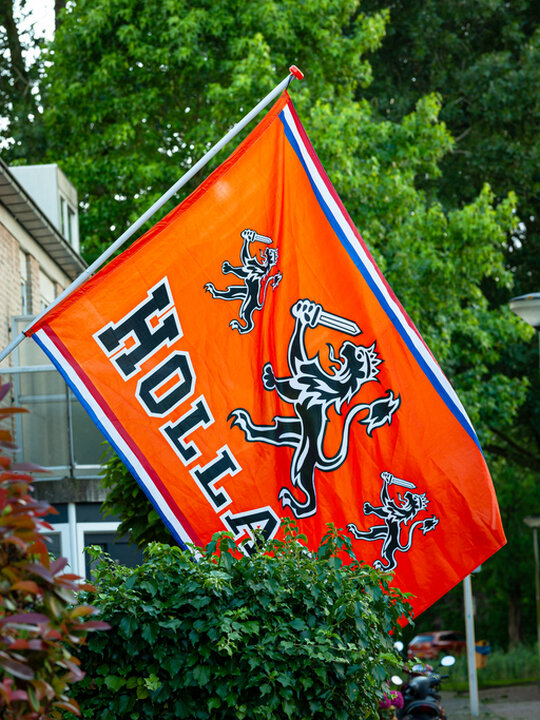
Orange is not just a colour in the Netherlands. It is connected to the Dutch royal family, the House of Orange, and it has become the colour of Dutch national team spirit in sports. When the Dutch team plays, the country often turns orange.
You will see orange in shop windows, at schools, in offices and in the streets. People wear orange shirts, hats or scarves, and some neighbourhoods decorate entire streets. Even if you are not a football fan, it is hard to miss.
During a World Cup, orange is not only a colour. It is a sign that something collective is happening.
Oranje
Oranje means orange, but in football it also means the Dutch national team.
So when someone says:
Oranje speelt vanavond.
They mean:
The Netherlands are playing tonight.
You may also hear people say we when they talk about the team. We moeten winnen means “we have to win”, even though most people are watching from the sofa. Sport has a way of turning spectators into a temporary “we”.

Oranjegekte
Gekte means madness. So Oranjegekte literally means orange madness.
You may notice:
- orange shirts and scarves
- flags in windows
- face paint
- decorated houses
- colleagues with sudden tactical opinions
- snacks that somehow also turn orange
It can be playful, loud and a little over the top. Usually, that is part of the fun. Dutch people may often value modesty, but during football tournaments, they allow themselves to be visibly enthusiastic together.
Versierde straten
One of the most striking Dutch football habits is the decorated street: versierde straten. In some neighbourhoods, residents hang orange flags, banners and bunting from house to house. Sometimes an entire street becomes an Oranjestraat.
This says something about Dutch neighbourhood culture. It is social, but also organised: someone takes the initiative, neighbours agree, decorations are arranged and the street slowly becomes part of the tournament.
For expats, it can be a friendly opening. A simple sentence like Wat leuk, al die versiering — “How nice, all these decorations” — can start a conversation with a neighbour. You do not need perfect Dutch to make contact.
Hup Holland Hup
Hup Holland Hup is a classic Dutch football cheer. It means something like: “Come on, Netherlands!” You can say it during a match, before a match or when you simply want to join the football mood. People will understand the intention, even if your pronunciation is not perfect.
And yes, it says Holland, not Nederland. Strictly speaking, Holland is only part of the Netherlands. But in football songs and cheers, many people use it informally to mean the whole country.
De poule
During a tournament, you will often hear the word poule. It means the group of teams that play against each other in the first phase.
Useful phrases:
Nederland zit in een lastige poule.
The Netherlands are in a difficult group.
Wie gaat er door in de poule?
Who will go through from the group?
We moeten deze wedstrijd winnen.
We have to win this match.
Words like these help you follow small conversations around you. And those small conversations often matter, because they make it easier to take part in informal moments at work or in daily life.
Buitenspel
Buitenspel is the Dutch word for offside. If you know football, you know it can be a difficult rule to explain. If you do not know football, you are not alone.
But the word is useful beyond football too. In Dutch, buitenspel staan can also mean being left out or no longer being involved.
That makes it a strong metaphor for what expats sometimes experience. When everyone around you switches to Dutch, you may suddenly feel buitenspel. Learning Dutch helps you move back into the conversation, one word at a time.
Gezellig kijken
Many Dutch people watch football together: at home, in a café, at work or outside on a big screen. They might invite you by saying: Kom je gezellig kijken?
The word gezellig is difficult to translate. It can mean cosy, pleasant, friendly, sociable or simply nice to be together. In this context, the match matters, but the togetherness may matter just as much.
A small cultural clue: when someone invites you to do something gezellig, the real invitation is often not only to the activity. It is to the moment.
Nabeschouwen
After the match, the talking continues. This is called nabeschouwen: looking back and discussing what happened. You will see it on television, but also hear it at work the next day. Was the referee right? Did the coach make the right choices? Should that one player have passed the ball?
This habit is not limited to football. Dutch people often like to analyse, evaluate and give their opinion. In meetings and projects too, people may discuss quite directly what went well and what could be better.
More than football words
Football words can be a playful way into the Dutch language. They show how people connect, how humour works, how neighbours interact and how informal conversations begin.
When you learn Dutch, you do not only learn vocabulary and grammar. You also learn to recognise tone, habits and shared references. That makes daily life easier and helps you feel less like an observer.
You do not have to speak perfect Dutch to feel more at home. Every word you learn gives you more access to the world around you, from a conversation with colleagues to a street full of orange flags.
Learn Dutch. Understand the culture behind the words.
At Regina Coeli, you learn Dutch in a focused and personal way, with attention to your goals, your pace and the situations in which you want to communicate. Whether you want to speak more confidently at work, understand everyday conversations or feel more at home in the Netherlands, language is the key to taking part.
Discover our Dutch language training >