Why tapas are more than just food: learn Spanish at the bar
What do a slice of jamón, a glass of wine, and a lid have in common? You guessed it: tapas. This delicious Spanish tradition is famous around the world. But if you’ve ever experienced a real tapeo in Spain, you’ll know that tapas are more than just small plates. Tapas are language. Tapas are culture. Tapas are Spain — something you can hear, taste and feel.
In this article, we take you back to the roots of tapas, introduce you to some classic Spanish bar vocabulary, and give you a flavour of the colourful expressions that make Spanish such a rich and tasty language. Buen provecho.
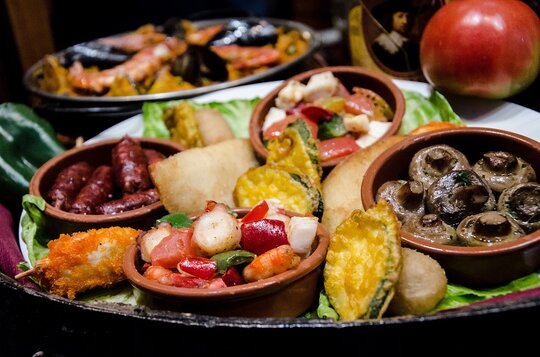
Kings and cheese lids: where tapas come from
There’s no single official origin story for tapas — but there are plenty of great theories:
The lid theory
In old taverns, a slice of bread, cheese or ham was placed on top of a wine glass to keep out dust and flies. A tapa (from tapar, meaning “to cover”) was quite literally a little edible lid.
The royal command
King Alfonso XIII once stopped at a bar in Andalusia and asked for a glass of wine. Because it was windy, the waiter placed a slice of ham on top. The king liked the idea so much, he decreed that drinks should always be served with a tapa.
Medieval inns
Travellers stopping at roadside inns would get a small bite to eat on top of the cooking pot’s lid. Not exactly a menu, but a taste of the day’s dish.
Whether or not they’re historically accurate, these stories have become part of Spain’s cultural heritage. Today, tapas are all about coming together, tasting, chatting and enjoying life — and yes, the Spanish language is an essential part of the experience.
Spanish at the tapas bar: the tastiest way to learn
If you’ve ever stood at the bar of a lively Spanish tapería, you know how fast things move. No one’s waiting for you to check your dictionary — which makes it the perfect place to learn Spanish as it’s really spoken.
Here’s a quick tapas glossary:
- Tapa – small individual dish
- Ración – larger portion (for sharing)
- Media ración – half portion
- Pincho / pintxo – snack on bread, often with a skewer (typical in the Basque Country)
- Tapear / ir de tapeo / ir de tapas – to go on a tapas crawl (bar-hopping for food)
- Caña – small draught beer
- Vino tinto / vino blanco – red / white wine
- Carta – the (menu) list
- Comanda – the order
- Camarero / camarera – waiter / waitress
- Cuenta – the bill

Spanish expressions: full of flavor
For Spaniards, food isn’t just nutrition — it’s emotion, expression and even philosophy.
No wonder the Spanish language is packed with food idioms. Here are a few that you’re bound to hear:
1. Ser pan comido
Literally: to be eaten bread
Meaning: it’s a piece of cake
“That presentation? Pan comido, hombre.”
2. Tener mala leche
Literally: to have bad milk
Meaning: to be in a bad mood or have a bad temper
“No le hables, hoy tiene mala leche.”
3. Estar de mala uva
Literally: to be in a bad grape
Meaning: to be grumpy
Perfect for someone who’s not a morning person — and yes, wine is sacred in Spain.
4. Importar un pepino / pimiento
Literally: I care a cucumber / pepper
Meaning: I don’t care at all
“¿Que se va? Me importa un pepino.” — With a healthy dose of nonchalance.
5. No está el horno para bollos
Literally: the oven isn’t ready for pastries
Meaning: now’s not the right time
When someone brings up a tough topic during tapas, just say: el horno no está para bollos.
6. Ser un chorizo
Literally: to be a chorizo sausage
Meaning: to be a thief
Watch out — not every chorizo is to be trusted!
These kinds of idioms bring your Spanish to life — and the best part? You often pick them up naturally, just by chatting in real-life settings. Exactly the kind of context-rich learning we offer at Regina Coeli.
Tapas as a social ritual
Tapas aren’t just about food. They’re about community. You order, you share, you talk. As the Spanish say: compartir es vivir – sharing is living.
Here’s what makes the culture so unique:
- You don’t stay in one spot. A tapeo means hopping from bar to bar.
- Eating standing up is normal — many locals eat at the bar, maybe perched on a stool.
- Tapas are sometimes free. In places like Andalusia, you’ll get a free tapa with your drink.
- Menus vary by season and region. Tapas reflect what’s fresh and local.
Learn Spanish with flavour at Regina Coeli
Want to speak Spanish like the locals in a tapas bar? Understand what’s being said — and how to say it yourself? Then a Spanish course at Regina Coeli is the perfect way to build your language skills and cultural insight. ¡Nos vemos pronto!
Explore our Spanish training at Regina Coeli
More about Spanish language and culture

10 Spanish sayings that make your language sound more natural
You’re learning Spanish. You can already hold a conversation, but something’s still missing — that feeling of really being in the language. Sounding like a native speaker. There’s one simple but powerful way to take your Spanish to the next level: use sayings. Once you know how to use common Spanish expressions, your Spanish instantly becomes more colourful and natural.
Add rhythm to your Spanish learning with music
Who says learning Spanish has to be serious and structured all the time? Add a little salsa, a reggaetón beat, or a dose of Spanish indie and suddenly you're picking up new vocabulary without even trying.
How well can you learn Spanish using Duolingo?
You would not stroll around with a sombrero on your head in Spain. Nor would you run into a mariachi band in a square. So why would you learn Mexican Spanish for your holidays in Spain? A lot of people use Duolingo to learn Spanish, and for good reason. With its cheerful little owl and short, interactive lessons, Duolingo makes learning a new language feel accessible. And it can be handy for those who want to pick up a phrase or two for a holiday in Spain. But did you know that Duolingo mainly focuses on Latin American Spanish?